Download the free Kindle app and start reading Kindle books instantly on your smartphone, tablet, or computer - no Kindle device required.
Read instantly on your browser with Kindle for Web.
Using your mobile phone camera - scan the code below and download the Kindle app.
Follow the authors
OK
The Great Mental Models, Volume 1: General Thinking Concepts (The Great Mental Models Series)
Purchase options and add-ons
This first book in the series is your guide to learning the crucial thinking tools nobody ever taught you.
Time and time again, great thinkers such as Charlie Munger and Warren Buffett have credited their success to mental models–representations of how something works that can scale onto other fields.
Mastering a small number of mental models enables you to rapidly grasp new information, identify patterns others miss, and avoid the common mistakes that hold people back.
The Great Mental Models: Volume 1, General Thinking Concepts shows you how making a few tiny changes in the way you think can deliver big results.
Drawing on examples from history, business, art, and science, this book details nine of the most versatile, all-purpose mental models you can use right away to improve your decision making and productivity.
This book will teach you how to:
- Avoid blind spots when looking at problems.
- Find non-obvious solutions.
- Anticipate and achieve desired outcomes.
- Play to your strengths, avoid your weaknesses,
The Great Mental Models series demystifies once elusive concepts and illuminates rich knowledge that traditional education overlooks. This series is the most comprehensive and accessible guide on using mental models to better understand our world, solve problems, and gain an advantage.
- Print length208 pages
- LanguageEnglish
- PublisherPortfolio
- Publication dateOctober 15, 2024
- Dimensions5.75 x 0.74 x 8.5 inches
- ISBN-100593719972
- ISBN-13978-0593719978
Book recommendations, author interviews, editors' picks, and more. Read it now.
Explore your book, then jump right back to where you left off with Page Flip.
View high quality images that let you zoom in to take a closer look.
Enjoy features only possible in digital – start reading right away, carry your library with you, adjust the font, create shareable notes and highlights, and more.
Discover additional details about the events, people, and places in your book, with Wikipedia integration.
Frequently bought together

Customers who viewed this item also viewed

The Great Mental Models, Volume 2: Physics, Chemistry, and Biology (The Great Mental Models Series)HardcoverFREE Shipping on orders over $35 shipped by AmazonGet it as soon as Thursday, Jun 11
Thinking in Systems: International BestsellerPaperbackFREE Shipping on orders over $35 shipped by AmazonGet it as soon as Thursday, Jun 11
The Great Mental Models, Volume 4: Economics and Art (The Great Mental Models Series)HardcoverFREE Shipping on orders over $35 shipped by AmazonGet it as soon as Thursday, Jun 11
The Great Mental Models, Volume 3: Systems and Mathematics (The Great Mental Models Series)HardcoverFREE Shipping on orders over $35 shipped by AmazonGet it as soon as Thursday, Jun 11
Clear Thinking: Turning Ordinary Moments into Extraordinary ResultsHardcoverFREE Shipping on orders over $35 shipped by AmazonGet it as soon as Thursday, Jun 11
Customers also bought or read
- Clear Thinking: Turning Ordinary Moments into Extraordinary Results
Hardcover$16.91$16.91Delivery Thu, Jun 11 - The Great Mental Models Volume 3: Systems and Mathematics
Hardcover$98.64$98.64FREE delivery Thu, Jun 11 - Mental Models: An AI’s Guide to 100 Thinking Tools That Humans Overlook (So You Can Outsmart Anyone) (Think Smarter)
Paperback$17.54$17.54Delivery Thu, Jun 11 - Thinking in Bets: Making Smarter Decisions When You Don't Have All the Facts
Paperback$15.62$15.62Delivery Thu, Jun 11 - The Almanack of Naval Ravikant: A Guide to Wealth and Happiness
Hardcover$19.96$19.96Delivery Thu, Jun 11 - Fooled by Randomness: The Hidden Role of Chance in Life and in the Markets (Incerto)#1 Best SellerStatistics
Paperback$12.68$12.68Delivery Thu, Jun 11 - The Book of Elon: A Guide to Purpose and Success
Just releasedPaperback$17.70$17.70Delivery Thu, Jun 11 - Thinking, Fast and Slow#1 Best SellerDecision-Making & Problem Solving
Paperback$11.77$11.77Delivery Thu, Jun 11 - Influence, New and Expanded: The Essential Guide to the Psychology of Influence and Persuasion in Everyday Life
Hardcover$18.99$18.99Delivery Thu, Jun 11 - All I Want To Know Is Where I'm Going To Die So I'll Never Go There: Buffett & Munger – A Study in Simplicity and Uncommon, Common Sense
Hardcover$37.90$37.90FREE delivery Thu, Jun 11 - Good Strategy Bad Strategy: The Difference and Why It Matters
Hardcover$20.18$20.18Delivery Thu, Jun 11 - First Principles Thinking: Mental Models for Thinking Clearly and Making Better Decisions
Just releasedPaperback$19.99$19.99Delivery Thu, Jun 11 - Think Like a Rocket Scientist: Simple Strategies You Can Use to Make Giant Leaps in Work and Life
Paperback$9.99$9.99Delivery Thu, Jun 11 - The Art of Thinking Clearly: The International Bestseller That Improves Decision Making and Counters Faulty Reasoning with Research-Backed Good Sense
Paperback$8.99$8.99Delivery Thu, Jun 11 - The Origins of Efficiency#1 Best SellerIndustrial Manufacturing
Hardcover$25.30$25.30Delivery Thu, Jun 11 - Tiny Experiments: How to Live Freely in a Goal-Obsessed World
Hardcover$18.46$18.46Delivery Jun 24 - 30 - Six Easy Pieces: Essentials of Physics Explained by Its Most Brilliant Teacher
Paperback$15.25$15.25Delivery Thu, Jun 11 - The Most Important Thing: Uncommon Sense for the Thoughtful Investor (Columbia Business School Publishing)
Hardcover$13.97$13.97Delivery Thu, Jun 11 - Lean Marketing: More leads. More profit. Less marketing.
Hardcover$20.50$20.50FREE delivery Jun 15 - 18 - Runnin' Down a Dream: How to Thrive in a Career You Actually Love
Hardcover$21.63$21.63Delivery Thu, Jun 11 - Orbiting the Giant Hairball: A Corporate Fool's Guide to Surviving with Grace
Hardcover$17.02$17.02Delivery Jun 15 - 18
From the Publisher
Vol 1
|
Vol 2
|
Vol 3
|
Vol 4
|
|
|---|---|---|---|---|
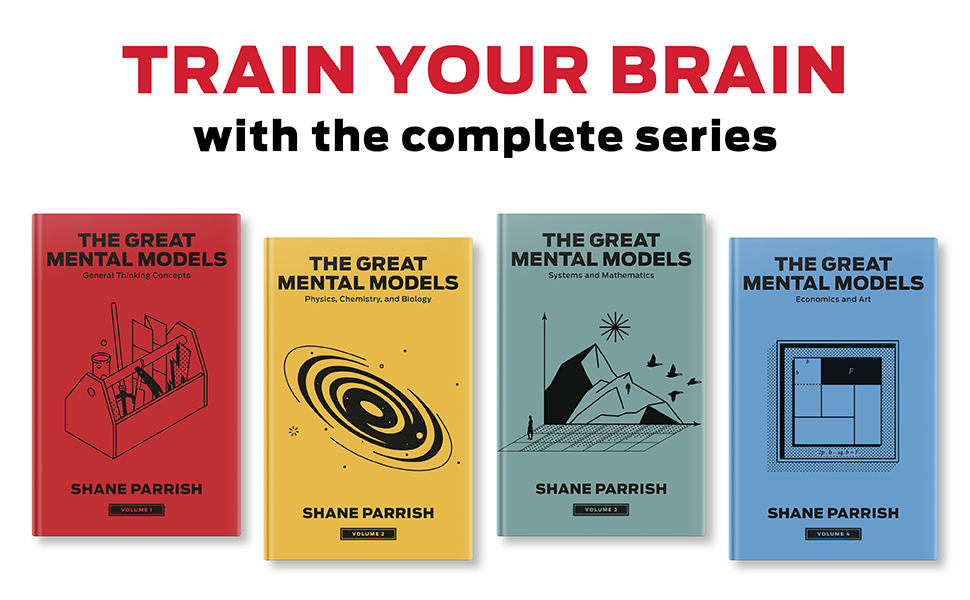
| Subject Matter | General Thinking Concepts | Physics, Chemistry, and Biology | Systems and Mathematics | Economics and Art |
| Concepts include… | The Map vs. The Territory, Second-Order Effects, Occam's Razor | Leverage, Inertia, Activation Energy | Compounding, Regression to the Mean, Law of Diminishing Returns | Creative Destruction, Representation, Genre |
| Page length | 208 | 400 | 384 | 416 |
| Illustrations throughout | x | x | x | x |
| New material | Fully revised and updated | Fully revised and updated | Fully revised and updated | Brand new volume with never-before-seen content |
Editorial Reviews
Review
— Matt Mullenweg, co-founder of WordPress, founder and CEO of Automattic
“If you’ve read Charlie Munger’s Almanack this is the book you deeply crave in its wake. … Learn the big ideas from the big disciplines and you’ll be able to twist and turn problems in interesting ways at unprecedented speeds. … You owe yourself this book.”
— Simon Eskildsen
“This is what non-fiction books should aspire to be like. Informative, concise, universal, practical, visual, sharing stories and examples for context. Definitely, a must-read if you’re into universal multi-disciplinary thinking.”
— Carl Rannaberg
“I can truly say it is one of the best books I’ve ever had the pleasure of getting lost in. I loved the book and the challenges to conventional wisdom and thinking it presents.”
— Rod Berryman
“Want to learn? Read This! This should be a standard text for high school and university students.”
— Code Cubitt
About the Author
Excerpt. © Reprinted by permission. All rights reserved.
You're only as good as your tools.
It is remarkable how much long-term advantage people like us have gotten by trying to be consistently not stupid, instead of trying to be very intelligent.
-Charlie Munger
In life and business, the person with the fewest blind spots wins. Blind spots are the source of all poor decisions. Think about it: If you had perfect information, you would always make the best decision. In a poker game where you could see everyone's cards, you'd play your hand perfectly. You wouldn't make any mistakes.
Unfortunately, we have a lot of blind spots. And while we can't eliminate them, we can reduce them. Reducing blind spots means we see, interact with, and move closer to understanding reality. We think better. And thinking better is about finding simple processes that help us work through problems from multiple dimensions and perspectives, allowing us to better choose solutions that fit the objective. The skill behind finding the right solutions for the right problems is one form of wisdom.
This book is about the pursuit of that type of wisdom-the pursuit of uncovering how things work, the pursuit of going to bed smarter than when we woke up. It is a book about getting out of our own way so we can better understand how the world really is. Decisions based on improved understanding will be better than ones based on ignorance. While, inevitably, we can't predict which problems will crop up in life, we can learn time-tested ideas that help position us for whatever the world throws at us.
Perhaps more importantly, this book is about avoiding problems. This often comes down to understanding a problem accurately and seeing the secondary and subsequent consequences of any proposed action. The author and explorer of mental models Peter Bevelin put it best: "I don't want to be a great problem solver. I want to avoid problems-prevent them from happening and do it right from the beginning."
How can we do things right from the beginning?
We must understand how the world works and adjust our behavior accordingly. Contrary to what we're led to believe, thinking better isn't about being a genius. It is about the processes we use to uncover reality and the choices we make once we do.
How This Book Can Help You
This is the first of four volumes aimed at defining and exploring the Great Mental Models-those with the broadest utility across our lives.
Mental models describe the way the world works. They shape how we think, how we understand, and how we form beliefs. Largely subconscious, mental models operate below the surface. We're not generally aware of them, and yet when we look at a problem, they're the reason we consider some factors relevant and others irrelevant. They are how we infer causality, match patterns, and draw analogies. They are how we think and reason.
A mental model is a compression of how something works. Any idea, belief, or concept can be distilled down. Like maps, mental models reveal key information while ignoring the nonessential. For example, you likely have a useful idea about how inertia works, even though you don't know all the technical details.
Mental models help us better understand the world. While this might sound a bit academic, it's not. For example, velocity helps us understand that both speed and direction matter. Reciprocity helps us understand how going positive and going first gets the world to do most of the work for us. The idea of a margin of safety helps us understand that things don't always go as planned. Relativity shows us how a different perspective changes everything. The list goes on.
It doesn't matter what the model is or where it comes from-the question to ask yourself is whether it is useful. The world is not divided into distinct disciplines. For example, business professors won't discuss physics in their lectures, but they should. Velocity teaches us that going in the right direction matters more than how fast you go. Kinetic energy teaches us that your company's velocity matters more than its size when creating an impact in the market. Understanding and applying these insights helps you outperform your competition.
While it helps to think of each model as a map, collectively they act as lenses through which you can see the world. Each lens (model) offers a different perspective, revealing new information. Looking through one lens lets you see one thing, and looking through another reveals something different. Looking through them both reveals more than looking through each one individually.
Whether we realize it or not, mental models help us think at the subconscious level. They shape what we see, what we choose to ignore, and what we miss entirely. While there are millions of mental models, these volumes focus on the ones with the greatest utility-the all-star team of mental models.
Volume 1 presents the first nine models, which are general thinking concepts. Although these models are hiding in plain sight, they are useful tools that you likely were never directly taught. Put to proper use, they will improve your understanding of the world we live in and your ability to look at a situation through different lenses, each of which reveals a different layer. They can be used in a wide variety of situations and are essential to making rational decisions, even when there is no clear path. Collectively, they will allow you to walk around any problem in a three-dimensional way.
Our approach to the Great Mental Models rests on the idea that the fundamentals of knowledge are available to everyone. There is no discipline that is off-limits-the core ideas from all fields of study contain principles that reveal how the universe works and are therefore essential to navigating it. Our models come from fundamental disciplines that most of us have never studied, but no prior knowledge is required, only a sharp mind with a desire to learn.
Why Mental Models?
There is no system that can prepare us for all risks. Factors of chance introduce a level of complexity to any situation that is not entirely predictable. But being able to draw on a repertoire of timeless mental models can help us minimize risk by better understanding the forces that are at play. Likely consequences don't have to be a mystery.
Not having the ability to shift perspective by applying knowledge from multiple disciplines makes us vulnerable. Mistakes can become catastrophes whose effects keep compounding, creating stress and limiting our choices. Multidisciplinary thinking-learning these mental models and applying them across our lives-creates less stress and more freedom. The more we can draw on the diverse knowledge contained in these models, the more solutions will present themselves.
Understanding Reality
"Understanding reality" is a vague phrase, one you've already encountered a few times as you've read this book. Of course, we want to understand reality, but how do we do that? And why is it important?
In order to see a problem for what it is, we must first break it down into its substantive parts, so the interconnections can reveal themselves. This bottom-up perspective allows us to expose what we believe to be the causal relationships within the problem and determine how they will govern the situation both now and in the future. Being able to accurately describe the full scope of a situation is the first step to understanding it.
Using the lenses of our mental models helps us illuminate these interconnections. The more lenses used on a given problem, the more reality reveals itself. The more of reality we see, the fewer blind spots we have. The fewer blind spots we have, the better the options at our disposal.
Simple and well-defined problems won't need many lenses, as the variables that matter are known; so too are the interactions between them. In such cases, we generally know what to do to get the intended result with the fewest side effects possible. When problems are more complicated, however, the value of having a brain full of lenses becomes readily apparent.
That's not to say all lenses (or models) apply to all problems. They don't. And it's not to say that having more lenses (or models) will be an advantage in thinking through all problems; it won't. This is why learning and applying the Great Mental Models is a process that takes some work. But the truth is, most problems are multidimensional, and thus having more lenses often offers significant help with the problems we are facing.
Keeping Your Feet on the Ground
In Greek mythology, Antaeus was the human-giant son of Poseidon, god of the sea, and Gaia, Mother Earth. Antaeus had a strange habit: he would challenge all those who passed through his country to a wrestling match. As in wrestling today, the goal was to force the opponent to the ground. Antaeus always won, and his defeated opponents' skulls were used to build a temple to his father. While Antaeus was undefeated and nearly undefeatable, there was a catch to his invulnerability. His epic strength depended on constant contact with the earth; when he lost touch with the earth, he lost all his strength. The great hero lost to Heracles, who simply lifted him off the ground.
On the way to the Garden of the Hesperides, Heracles was to fight Antaeus as one of his twelve labors. After a few rounds in which Heracles flung the giant to the ground, only to watch him revive, he realized he could not win by using traditional wrestling techniques. Instead, Heracles fought to lift Antaeus off the ground. With the earthly connection broken, Antaeus was separated from the source of his power, causing him to lose his strength. From that point on, it was easy for Heracles to crush him.
When understanding is separated from reality, we lose our powers to make better decisions. Understanding must constantly be tested against reality and updated accordingly. This isn't a box we can tick, a task with a definite beginning and end, but rather a continuous process.
We all know the person who seems to have all the answers. They know how to fix all the problems at work, solve world hunger, and get in shape (if only they wanted to). If you don't test your ideas against the real world-if you don't keep contact with the earth-how can you be sure you understand it? While pontificating with friends over a bottle of wine at dinner can be fun, the only way you'll know the extent to which you understand reality is to put your ideas into action.
Getting in Our Own Way
The biggest barrier to learning from the world is ourselves. It's hard to understand a system that we are part of because we have blind spots, where we can't see what we aren't looking for and don't notice what we don't notice.
There are these two young fish swimming along, and they happen to meet an older fish, swimming the other way, who nods at them and says, "Morning, boys. How's the water?" And the two young fish swim on for a bit, and then eventually one of them looks over at the other and goes, "What the hell is water?"
-David Foster Wallace
Our failures to update our mental models as we interact with the world spring primarily from three factors: not having the right perspective or vantage point, ego-induced denial, and distance from the consequences of our decisions. As we will learn in greater detail throughout these volumes on mental models, all of these can get in the way. They make it easier to keep our existing and flawed beliefs than to update them accordingly. Let's briefly flesh out these flaws:
The first flaw is failure of perspective. We have a hard time seeing any system that we are a part of. We think our angle of perception is the right one and the only one.
Galileo had a great analogy to describe the limits of our default perspective: Imagine you are on a ship that has reached constant velocity (meaning there is no change in speed or direction). You are belowdecks, and there are no portholes. You drop a ball from your raised hand to the floor. To you, it looks as if the ball is dropping straight down, thereby confirming gravity is at work.
Now imagine you are a fish (with special X-ray vision) and you are watching this ship go past. You see the scientist inside, dropping a ball. You register the vertical change in the position of the ball. But you are also able to see a horizontal change. As the ball was pulled down by gravity, it also shifted its position eastward by about twenty feet. The ship moved through the water, and therefore so did the ball. The scientist onboard, with no external point of reference, was not able to perceive this horizontal shift.
This analogy shows us the limits of our perception. If we truly want to understand the results of our actions, we must be open to other perspectives. Allowing for other perspectives is also key to having productive relationships with others.
The second flaw is ego-the part of us that's afraid and always in competition. The ego is easily triggered and never feels satiated. Many of us tend to have too much invested in our opinion of ourselves to see the world's feedback-the feedback we need to update our beliefs about reality. This creates a profound ignorance that keeps us repeatedly banging our heads against the wall. Our inability to learn from the world because of our ego arises for many reasons, but two are worth mentioning here. First, we're often so afraid of what others will say about us that we fail to put our ideas out there and subject them to criticism; this way, we can always be right. Second, if we do put our ideas out there, and they're criticized, our ego steps in to protect us-we become invested in defending, instead of upgrading, our ideas. This is antithetical to growth.
The third flaw is distance. The further we are from the results of our decisions, the easier it is to maintain our current views rather than update them. When you put your hand on a hot stove, you quickly learn the natural consequence of doing so. You pay the price for your mistake. Since you are a pain-avoiding creature, you instantly update your knowledge. Before you touch another stove, you check to see if it's hot. But you don't just learn a micro lesson that applies in one situation. Instead, you draw a generalization, one that tells you to check before touching anything that could potentially be hot.
Large organizations often remove us from the direct consequences of our decisions. When we make decisions that other people carry out, we are one or more levels removed from their consequences and may not immediately be able to update our understanding-we come a little off the ground, if you will. The further we are from the feedback on our decisions, the easier it is to convince ourselves that we are right and avoid the challenge, the pain, of updating our views.

Product details
- Publisher : Portfolio
- Publication date : October 15, 2024
- Language : English
- Print length : 208 pages
- ISBN-10 : 0593719972
- ISBN-13 : 978-0593719978
- Item Weight : 2.31 pounds
- Dimensions : 5.75 x 0.74 x 8.5 inches
- Book 1 of 4 : The Great Mental Models
- Best Sellers Rank: #22,734 in Books (See Top 100 in Books)
- #31 in Cognitive Psychology (Books)
- #34 in Business Decision Making
- #71 in Decision-Making & Problem Solving
- Customer Reviews:
About the authors

Shane Parrish is an entrepreneur, investor, and the wisdom seeker behind the popular website Farnam Street where he writes about hidden insights that you can use in life and business.
Parrish is a regular speaker and his work has been featured in places like The New York Times, The Wall Street Journal, and the Economist. His popular "Brain Food" newsletter is sent out to over 600k people each week and his podcast, The Knowledge Project, is one of the top in the world.
Parrish’s popular online course, Decision by Design, has helped thousands of executives, leaders, and managers worldwide learn the repeatable behaviors that improve decision-making results in the real world.

Discover more of the author’s books, see similar authors, read book recommendations and more.
Customer reviews
Customer Reviews, including Product Star Ratings help customers to learn more about the product and decide whether it is the right product for them.
To calculate the overall star rating and percentage breakdown by star, we don’t use a simple average. Instead, our system considers things like how recent a review is and if the reviewer bought the item on Amazon. It also analyzed reviews to verify trustworthiness.
Learn more how customers reviews work on AmazonCustomers say
Generated from the text of customer reviewsSelect to learn more
Reviews with images
Cover bound upside down.
Top reviews from the United States
- 5 out of 5 stars
Simple But Usable Advice
Reviewed in the United States on January 4, 2026When you read these concepts you probably will not be surprised by the main ideas. However, the book does a good of fleahing out the details to make the concepts clear and memorable and proper caveats of when to use the ideas. Simple advice is usually easier to apply and stopping to actually use these precepts will improve your decision making.
One person found this helpfulSending feedback...Sending feedback...HelpfulThank you for your feedback.Sorry, we failed to record your vote. Please try againThanks, we'll investigate in the next few days.Sorry, We failed to report this review. Please try again - 4 out of 5 stars
Great intro to mental models for the layperson!
Reviewed in the United States on March 13, 2025This book introduced several theories that, when simplified, allow us to think about things from different perspectives and allow for greater perspectives.
This is my first time reading about Occam's Razor, Hanlon's Razor and while I have used inversion thinking in the past, it was simply something I did, but now I understand it and its reasoning. For the layperson who has not been exposed to these theories before, I found the book to be a great read. While sometimes a bit overly complicated, I appreciated that the author offered the philosopher's perspective on the theory and then offered a more modern-day example so one could take the idea and understand it in its simplified form. I gave it 4 stars only because I wish it was a tad bit more simplified and more straightforward for us non-philiosopher types who are simply looking to better understand how to approach the world we live in.
4 people found this helpfulSending feedback...Sending feedback...HelpfulThank you for your feedback.Sorry, we failed to record your vote. Please try againThanks, we'll investigate in the next few days.Sorry, We failed to report this review. Please try again - 5 out of 5 stars
Top 5
Reviewed in the United States on December 22, 2022This is in the top ten books I’ve read. I’m planning to buy several of these to gift to close friends. If you’re intrigued by the notion of thinking better—more effectively, more decisively, more confidently—this book is an accessible treasure trove of practical information. If you’ve ever read Robert Greene and enjoyed it, this is written in a similar style without the diabolical tone and effect. Further, the design of it and reasonable price makes it an all around win. Just love it. Highly recommended! — from a guy who has a personal library of over a thousand books and reluctantly tells people I like to read when they ask what I do for fun.
17 people found this helpfulSending feedback...Sending feedback...HelpfulThank you for your feedback.Sorry, we failed to record your vote. Please try againThanks, we'll investigate in the next few days.Sorry, We failed to report this review. Please try again - 5 out of 5 stars
Great Book, worth reading..
Reviewed in the United States on January 18, 2022The book is great and it is worth pondering every single mental model he describes. You may already know some of them or even all of them but having it described and discussed before you sheds some lights on aspects of the model you may have ignored in your use of it. I was deeply enlightened by many of the book’s discussions. The use of stories of great men and women is well crafted in almost all discussions.
The only complaint I have is the naturalistic viewpoint that is preached in some parts of the book. I believe the author fails to apply the very thing he’s advocating for when he does that: a rational analysis of what is said. Take the Sagan example and do it by yourself, he throws one phrase from a scientist in the air as if the phrase was a scientific argument, which is clearly not. Note that the phrase in question is so damaging that it has been used many times to discredit important recent scientific discoveries.
Anyways, my 2 cents: focus on what the author do best and forget about his wandering into metaphysics.
12 people found this helpfulSending feedback...Sending feedback...HelpfulThank you for your feedback.Sorry, we failed to record your vote. Please try againThanks, we'll investigate in the next few days.Sorry, We failed to report this review. Please try again - 3 out of 5 stars
Redundant and not average person friendly. Overhyped.
Reviewed in the United States on July 11, 2022While some part of the content in this book is insightful and might be practical.
But from my perspective, 40% of its content is redundant and could be simplified.
The introduction chapter is redundant and hard for people to understand what is the focus.
The correlation and causation chapter is not average person-friendly, and is hard to understand.
but it could be improved from a math perspective.
10 people found this helpfulSending feedback...Sending feedback...HelpfulThank you for your feedback.Sorry, we failed to record your vote. Please try againThanks, we'll investigate in the next few days.Sorry, We failed to report this review. Please try again - 5 out of 5 stars
Life Changing!!!
Reviewed in the United States on May 10, 2019Excellent delivery by Shane.
He has such great insights and the ability to communicate complex ideas in a such a way that anyone is able to benefit. I have been following Shane and reading his content on his blog Farnam Street for quite a few months now. I was first exposed to the Mental Models on Shanes blog and was absolutely blown away. ANYONE can benefit from this audiobook and the application if its contents.
This audiobook will make you realize what you have been missing, help you to become a better problem solver, decision maker and provide overall clarity. It will supply you with the necessary tools in order to help you look at the world and the problems we encounter in multiple ways. Get ready for an eye opening experience.
Thank you Shane for putting together this content. Can’t wait for Volume 2!!!!
15 people found this helpfulSending feedback...Sending feedback...HelpfulThank you for your feedback.Sorry, we failed to record your vote. Please try againThanks, we'll investigate in the next few days.Sorry, We failed to report this review. Please try again - 4 out of 5 stars
Assortment of some very important thinking frameworks.
Reviewed in the United States on January 1, 2020This book is a consolidation of the wonderful mental models that Farnam Street has learned over the years from its highly distinguished guests. The cover image does a perfect TL;DR on what the book really is - it is an assortment of important thinking concepts (frameworks) that you want:
a) to be aware of, and
b) keep handy to apply
whenever you are thinking deeply about a problem or a life decision. It seems Shane Parrish has good motivations to assemble this because probably he is probably trying to teach all these models to his own kids.
Note, I use the word assemble (with intention) because it is certainly an assembly book. The book does
_not_ introduce some extensive new research or offer a brand new concept/model per se but rather is a nice consolidation of many important ideas in one single place -- the content is by no means author's original findings and they don't claim so either. Having said that, getting everything organized cohesively isn't easy at all, so kudos to them in my opinion. A clear read overall & definitely something to have in your bookshelf.
3 people found this helpfulSending feedback...Sending feedback...HelpfulThank you for your feedback.Sorry, we failed to record your vote. Please try againThanks, we'll investigate in the next few days.Sorry, We failed to report this review. Please try again - 5 out of 5 stars
Nothing new yet fantastically presented
Reviewed in the United States on November 4, 2025The Great mental models give us a refresher on some models that most of us already know but reintroduces them in a way that just makes them click together
Sending feedback...Sending feedback...HelpfulThank you for your feedback.Sorry, we failed to record your vote. Please try againThanks, we'll investigate in the next few days.Sorry, We failed to report this review. Please try again
Top reviews from other countries
Client d'Amazon5 out of 5 starsVery good
Reviewed in France on April 7, 2025What a great book !
Sending feedback...Thanks, we'll investigate in the next few days.Sorry, We failed to report this review. Please try again
Talal5 out of 5 starsImprove the way you think in the era of critical thinking
Reviewed in the United Arab Emirates on April 16, 2024The book introduces mental models and establishes a foundation for its future volumes.
Sending feedback...Thanks, we'll investigate in the next few days.Sorry, We failed to report this review. Please try again
kontiki92 out of 5 starsIt didn't live up to expectations and the book quality is poor
Reviewed in Poland on February 27, 2025First of all, I am very disappointed with the quality of the second edition of the book I received from Amazon. It arrived in poor condition, appearing used with a worn cover, which has only deteriorated further over time. "The author thanks the publisher 'Cornerstone Press' in the acknowledgments, but in reality, there's nothing to thank them for. I can't remember the last time I encountered such poor quality in a book.
From reviews I read, I am not the only one complaining about it.
Speaking about the book itself, in my opinion, it didn't live to my expectations. There are a few mental models presented in the book. Some are explained really well some only shallowly. Compared to the book "Clear Thinking" it lacks a bit of depth and analysis.
The book itself is 4/5 but due to the print quality the overall score drops to 2/5.


2 out of 5 starsIt didn't live up to expectations and the book quality is poor
Reviewed in Poland on February 27, 2025First of all, I am very disappointed with the quality of the second edition of the book I received from Amazon. It arrived in poor condition, appearing used with a worn cover, which has only deteriorated further over time. "The author thanks the publisher 'Cornerstone Press' in the acknowledgments, but in reality, there's nothing to thank them for. I can't remember the last time I encountered such poor quality in a book.
From reviews I read, I am not the only one complaining about it.
Speaking about the book itself, in my opinion, it didn't live to my expectations. There are a few mental models presented in the book. Some are explained really well some only shallowly. Compared to the book "Clear Thinking" it lacks a bit of depth and analysis.
The book itself is 4/5 but due to the print quality the overall score drops to 2/5.
Sending feedback...Thanks, we'll investigate in the next few days.Sorry, We failed to report this review. Please try again
David Abrahamsson1 out of 5 starsPoor quality
Reviewed in Sweden on January 17, 2025The book arrived in very poor condition . Would advise against buying the book fom this seller
Sending feedback...Thanks, we'll investigate in the next few days.Sorry, We failed to report this review. Please try again
Mario Giacomuzzi5 out of 5 starsGood
Reviewed in Germany on June 17, 2025Mental tools, liked the read.
Sending feedback...Thanks, we'll investigate in the next few days.Sorry, We failed to report this review. Please try again